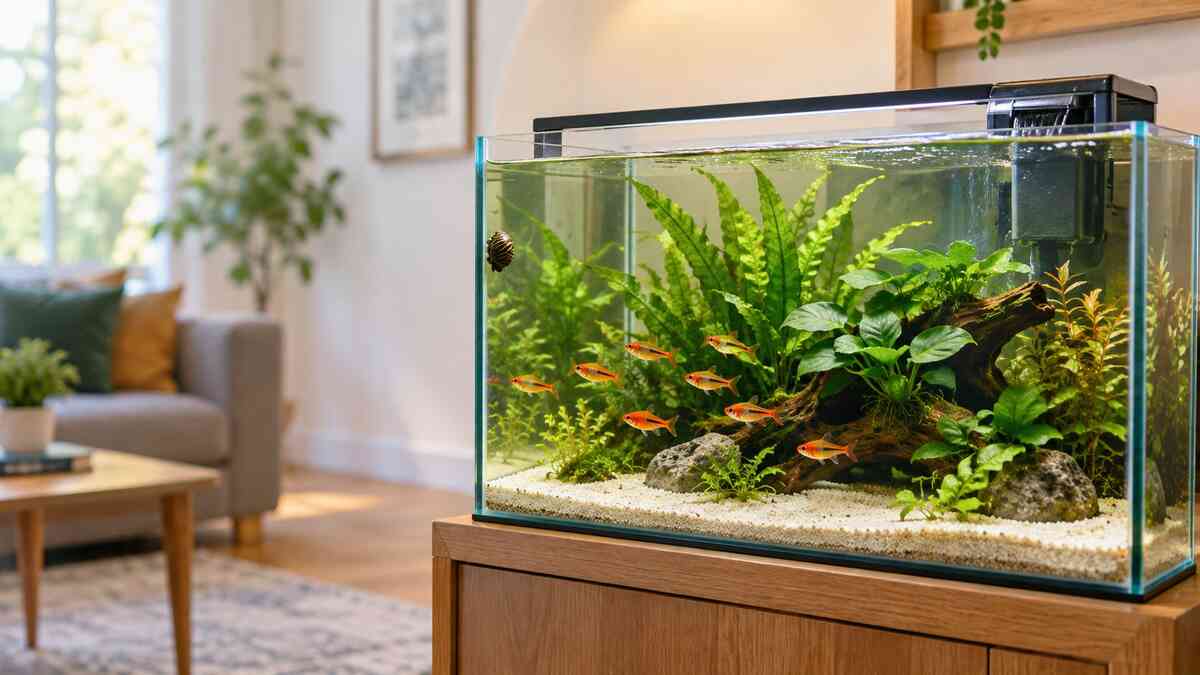
A 10-gallon tank is the most popular first aquarium, but its small water volume changes quickly, so the fish you choose matters more than most beginners expect. One wrong pick at the pet store can undo weeks of effort.
This guide covers the best aquarium fish for beginners with a 10-gallon setup. You’ll learn which species are hardy and realistic for this size, how many you can keep, which fish to skip, and how to prepare the tank so your first fish thrive.
Best Aquarium Fish for Beginners in a 10-Gallon Tank: Quick Picks
These fish are hardy, affordable, easy to find, and small enough to be comfortable in 10 gallons.
| Fish | Adult Size | Suggested Number | Difficulty |
| Neon tetra | 1.5 in | 6 | Easy |
| Ember tetra | 0.8 in | 8 to 10 | Easy |
| Harlequin rasbora | 2 in | 6 | Easy |
| Guppy (males) | 1.5 in | 3 to 5 | Easy |
| Pygmy or habrosus corydoras | 1 in | 6 | Easy |
| Betta (one only) | 2.5 in | 1 | Easy to moderate |
| Nerite snail | 1 in | 1 to 2 | Very easy |
Don’t buy any of them until your tank is cycled (see the cycling section below). Treat this list as your shopping plan, not your shopping trip.
What Makes a Fish Beginner-Friendly for a Small Aquarium?
“Easy” is often just a sales word. A genuinely beginner-friendly fish has these traits:
- Hardy. It tolerates small mistakes, like a missed water change or a slight temperature swing.
- Small adult size. A fish that stays under about 2.5 inches won’t outgrow a 10-gallon tank.
- Peaceful temperament. Aggressive or territorial fish stress everyone in a small space.
- Simple diet. It accepts common flakes, micro pellets, or frozen food.
- Common water needs. Most beginner fish do well in tropical freshwater around 76 to 80°F (24 to 27°C) with a stable, neutral pH.
- Easy to find and affordable. If one dies, replacing it shouldn’t be a hassle.
Stability matters more than perfection. Fish handle slightly imperfect water better than water that keeps changing, which is why a cycled, steadily maintained tank beats any fancy equipment.
How Many Fish Can You Keep in a 10-Gallon Aquarium?
You’ll often hear the “one inch of fish per gallon” rule. It’s a rough starting point, but it has flaws. A chunky, messy fish produces far more waste than a slim one, and schooling fish need groups regardless of the math.
A more practical approach:
- Choose one schooling species and keep a proper group, usually 6 or more.
- Add one small bottom-dweller or snail if you want variety.
- Leave room to grow. Don’t fully stock the tank on day one.
Sample 10-gallon stocking ideas
- Single-species school: 8 ember tetras and 1 nerite snail
- Mixed community: 6 harlequin rasboras and 6 pygmy corydoras
- Betta tank: 1 betta, 1 to 2 nerite snails, and live plants
- Colorful starter: 4 male guppies and 1 nerite snail
Start with half the group, wait two to three weeks, then add the rest. This gives your filter time to catch up with the extra waste.
Easy Community Fish: Tetras, Guppies, Rasboras and Corydoras
Community fish are peaceful species that live well together. In a 10-gallon tank, small schooling fish are the strongest choice because they add movement and color without crowding the space.
Neon and ember tetras
Neon tetras, with their blue and red stripe, are the classic beginner fish. They’re peaceful and affordable, but they do best in groups of six or more and in stable water. Buy them from a store that keeps its stock healthy, since weak fish are a common problem.
Ember tetras are even smaller and a great fit for 10 gallons. Their orange-red color looks striking against green plants, and you can keep 8 to 10 comfortably.
Harlequin rasboras
Harlequin rasboras are calm, sturdy, and easy to feed. They school tightly, so a small group looks impressive. Six is a good starting number.
Guppies
Guppies are hardy, colorful, and active, which makes them a favorite for first tanks. The catch is that they breed fast. Keep males and females together and you’ll have a tank full of fry within weeks. To avoid that, keep only males.
Pygmy and habrosus corydoras
Standard corydoras catfish grow too large and need bigger groups, so stick to the dwarf types. Pygmy and habrosus corydoras stay around one inch and scoot along the bottom. Use sand or smooth, fine gravel so their delicate barbels aren’t damaged.
Betta Fish: A Centerpiece Option for Beginners
A centerpiece fish gives your tank a focal point, and in a 10-gallon tank the betta is the obvious choice.
Is a betta right for you?
Bettas are bold, beautiful, and surprisingly interactive. They need warm water (around 78 to 80°F), a gentle filter, and plants or soft decor so their long fins don’t tear.
The key rule: keep only one male betta per tank. Males fight, and even female groups (sororities) are a poor choice for beginners.
Can a betta live with other fish?
Sometimes, but it depends on the individual fish. Some bettas ignore tank mates, while others attack anything that moves. If you want to try:
- Choose calm, non-fin-nipping fish like ember tetras or pygmy corydoras.
- Avoid guppies, since their flowing tails can trigger bettas.
- Have a backup plan, such as a spare tank, in case it doesn’t work.
For a low-stress setup, a betta with a couple of nerite snails and plenty of plants is a reliable choice.
Which Beginner Fish Get Along? Compatibility Guide
Compatibility problems are among the most common beginner headaches. Fish that look fine together in a store can clash at home.
Generally safe combinations in 10 gallons:
- Ember tetras with pygmy corydoras
- Harlequin rasboras with pygmy corydoras
- Neon tetras with nerite snails
- Guppies with nerite snails
Combinations to avoid:
- Betta with guppies
- Betta with other bettas
- Any small fish with larger, predatory species
- Fast, fin-nipping fish with slow, long-finned ones
Before buying, check three things: adult size, temperament, and preferred water conditions. If any of the three clash, choose a different fish.
Fish to Avoid in a 10-Gallon Tank (Common Mistakes)
Pet stores sometimes sell fish that look tiny but grow large, and that’s where many beginners go wrong. Skip these in a 10-gallon tank:
- Goldfish. They grow big, produce heavy waste, and need far more space than a small tank offers.
- Common pleco. It’s sold as a tiny algae eater but can reach over a foot long.
- Angelfish. They grow tall and need a taller, larger tank.
- Cichlids like oscars or most African cichlids. They’re territorial and outgrow small tanks quickly.
- Tiger barbs. They’re active fin-nippers that stress calmer fish.
- Pufferfish and other aggressive species. They’re not beginner-friendly at any size.
Before buying any fish, check its full-grown size. The RSPCA also advises owners to think about how big a fish will grow. If the store label only gives the baby size, that’s a warning sign.
How to Cycle Your Tank Before Adding Fish
This is the step beginners skip most, and it causes the most losses. Cycling means growing helpful bacteria that turn toxic fish waste into safer compounds.
The process works in three stages:
- Fish waste and leftover food produce ammonia, which is toxic.
- One type of bacteria converts ammonia into nitrite, which is also toxic.
- A second type converts nitrite into nitrate, which is far less harmful and is removed with water changes.
A tank is cycled when it can process ammonia and nitrite down to zero within about 24 hours, with some nitrate showing on the test.
How to do a fishless cycle
- Set up the tank with the filter, heater, and substrate running.
- Add a source of ammonia, such as pure liquid ammonia (no soaps or scents) or a small pinch of fish food.
- Test the water every few days with a liquid test kit.
- Wait until ammonia and nitrite both read zero and nitrate appears.
This usually takes four to six weeks. Bottled bacteria can speed things up, but confirm the result with your test kit.
10-Gallon Aquarium Setup: Filter, Heater and Plants
You don’t need expensive gear, but a few items are essential.
Filter
Choose a filter rated for 10 gallons or slightly more. A sponge filter or small hang-on-back filter works well. For bettas and long-finned fish, keep the flow gentle.
Heater
Most beginner fish are tropical. An adjustable heater with a thermometer keeps the temperature steady, which is the real goal. A 25 to 50 watt heater suits a 10-gallon tank.
Lighting
A basic LED light on a timer is enough. Aim for 6 to 8 hours a day, since too much light leads to algae.
Substrate and decor
Sand or fine gravel both work. Add a few hiding spots, like caves or driftwood, so fish feel safe.
Live plants
Live plants absorb nitrates, compete with algae, and give fish cover. Easy options include:
- Java fern
- Anubias
- Java moss
- Cryptocoryne
None of these need special lighting or fertilizers, which makes them ideal for a first tank.
Water conditioner and test kit
Use a water conditioner every time you add tap water. Also buy a liquid test kit that measures ammonia, nitrite, and nitrate. It’s the most useful tool you’ll own.
Feeding and Daily Care Tips for Beginner Fish Keepers
Once your tank is cycled and stocked, good care is mostly routine.
How to feed
Feed small amounts once or twice a day, only what the fish finish in about two minutes. Overfeeding is the top cause of cloudy water and ammonia spikes. A quality flake or micro pellet works as a staple, with occasional frozen or live food as a treat.
Weekly routine
- Change 20 to 25 percent of the water once a week.
- Use a gravel vacuum to remove waste from the substrate.
- Treat new tap water with conditioner and match the temperature.
- Test the water if anything looks off.
Monthly routine
- Rinse filter media in old tank water, not tap water, which can kill helpful bacteria.
- Wipe algae from the glass.
- Check equipment such as the heater and filter flow.
Signs of a healthy tank
- Fish swim actively and eat eagerly.
- Water stays clear.
- Colors look bright, not faded.
If fish gasp at the surface, hide constantly, or clamp their fins, test your water first. Water problems are the most likely cause.
Cost of a Beginner Fish Tank: What to Budget
Prices vary by country and store, so treat these as rough ranges.
| Item | Typical Cost Range (USD) |
| 10-gallon tank kit (tank, light, basic filter) | $40 to $90 |
| Heater | $15 to $30 |
| Substrate | $10 to $25 |
| Decor and hiding spots | $10 to $30 |
| Live plants | $10 to $25 |
| Water conditioner | $6 to $12 |
| Liquid test kit | $20 to $35 |
| Fish | $15 to $50 |
| Estimated total | $125 to $300 |
A few ways to save without cutting corners:
- Buy a tank kit instead of separate parts.
- Check local marketplaces for used tanks, but replace used filters and heaters if they look worn.
- Prioritize the test kit and heater, since they save you money in lost fish.
- Choose hardy, inexpensive fish like guppies and rasboras.
Remember the ongoing costs: food, conditioner, replacement filter media, and electricity.
FAQs
What is the easiest fish to keep in a 10-gallon tank?
Guppies, harlequin rasboras, and ember tetras are among the easiest. Nerite snails are also very low maintenance, though they’re snails rather than fish.
How many fish can I put in a 10-gallon tank?
Roughly 6 to 10 small fish, depending on the species. Keep one schooling group, add a small bottom-dweller if you like, and avoid stocking everything at once.
Can I put a betta with other fish in a 10-gallon tank?
Sometimes. Calm tank mates like ember tetras or pygmy corydoras are the best bet. Avoid guppies and other bettas, and be ready to separate them if aggression appears.
How long should I wait before adding fish to a new tank?
Usually four to six weeks for a full fishless cycle. Add fish only when ammonia and nitrite read zero and nitrate shows on your test kit.
What is the cheapest beginner fish?
Guppies, danios, and some tetras and rasboras are usually the most affordable. Prices differ by region, so check your local store.
Are goldfish good beginner fish?
Not for a 10-gallon tank. Goldfish grow large and produce a lot of waste, so they need a much bigger aquarium.
Do I need a heater for beginner fish?
For most tropical fish, yes. A stable temperature matters more than hitting an exact number, and a heater keeps it steady.
Conclusion
Choosing the best aquarium fish for beginners comes down to a few simple rules: pick small, hardy, peaceful species, keep schooling fish in proper groups, and never skip the cycling step. In a 10-gallon tank, ember tetras, harlequin rasboras, guppies, pygmy corydoras, and a single betta give you plenty of variety without the headaches.
Start with a good filter, a heater, live plants, and a test kit. Add fish slowly, feed lightly, and keep up with weekly water changes.
Takeaway: Get the tank right first, then choose fish that fit it. A patient start is what separates a thriving aquarium from a failed one.