You’ve booked your road test and practiced for weeks, but you still don’t know what the examiner will ask you to do. If you’ve searched for the Georgetown DPS driving test route, you’ve probably noticed there’s no official map to download, and that uncertainty is what makes people nervous.
This guide covers how the Georgetown road test works, why the route isn’t fixed, which situations cause the most failures, and how to practice so test day feels routine. You’ll also find the documents and vehicle checks that can end a test before it starts, plus answers to common questions.
Is the Georgetown DPS Driving Test Route Actually Hard?
For most people who prepare properly, no. It’s a standard Texas road test, not a trick exam.
What makes it feel hard is the unknown. You don’t know the exact streets, a stranger is scoring you, and a mistake feels costly. Georgetown also mixes residential streets, busier roads, and school zones, so you need comfortable everyday driving rather than one memorized loop.
How hard it feels usually depends on you:
- Easier if you drive regularly in Georgetown or Williamson County and handle stop signs, turns, and lane changes without thinking.
- Harder if you’ve only practiced in empty lots or rely on a coach for every move.
- Hardest if nerves make you rush, skip mirror checks, or freeze at four-way stops.
The test checks whether you can drive safely and follow traffic laws. It isn’t designed to catch you out on obscure roads.
How the Georgetown Road Test Is Set Up and Scored
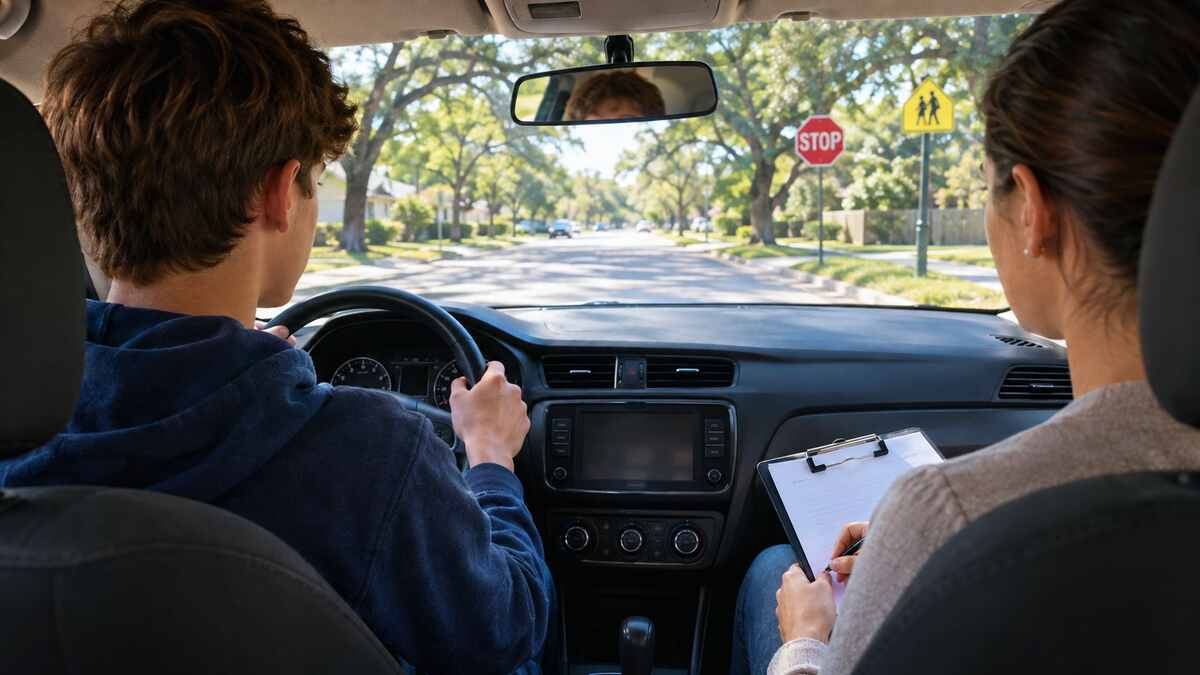
The Texas driver license road test is run by DPS examiners and takes roughly 20 minutes. You drive your own vehicle while the examiner rides along, gives directions, and watches how you handle the car.
You’ll generally be evaluated on:
- Backing in a straight line
- Approaching and moving through intersections
- Stopping in normal traffic
- Keeping proper position when turning and stopping
- Observation, signaling, and speed control
Perfection isn’t required. Examiners look for safe, legal, predictable driving, and small errors are normal. The goal is to avoid serious ones.
You’ll need to schedule an appointment through the official Texas DPS system and bring the right paperwork, covered below.
Does DPS Use a Fixed Route or Let Examiners Choose?
This is the question behind most searches for the Georgetown DPS driving test route. DPS doesn’t publish one official route. Examiners give turn-by-turn directions, and the path can change with traffic, time of day, construction, and the examiner.
That has two practical effects:
- Don’t pay for “the exact route.” Other test-takers may describe similar streets, but you can’t count on the same loop.
- Prepare for the area, not a path. If you’re comfortable with the roads and intersection types near the office, the order of turns won’t matter.
Some people report seeing familiar streets repeatedly. Treat that as a pattern, not a promise.
Streets and Areas Around the Georgetown DPS Office
Examiners start from the DPS office, so the nearby roads are the most likely to appear. Expect a mix of:
- Residential streets with stop signs, four-way stops, and parked cars
- Collector roads with moderate speed limits and lane positioning
- Busier intersections with traffic lights and turn lanes
- Parking areas for stopping and starting
Tip: Open the office address in Google Maps and use Street View to “drive” the surrounding blocks. You’ll learn where the turn lanes and signs are before you get behind the wheel.
Tricky Spots: School Zones, Stop Signs, and Speed Changes
Most mistakes happen in a few predictable places.
School zones
Reduced speed limits apply during school hours, and flashing beacons mean the limit is active. Slow down early instead of braking late. If your test falls near pickup or drop-off time, take extra care.
Stop signs and four-way stops
Make a complete stop behind the line. A rolling stop counts as a mistake. At a four-way stop, the first vehicle to arrive goes first. If you arrive together, yield to the vehicle on your right. If you’re unsure, wait and let the examiner see you being cautious.
Speed limit changes
Limits can change quickly when you move from a collector road to a neighborhood street. Watch for signs and adjust smoothly. Driving over the limit is a mistake, and so is driving so slowly that you hold up traffic.
Turns and lane position
Signal early and turn into the correct lane without cutting corners. Stay close to the right side on right turns. On left turns, wait for a safe gap instead of rushing.
Common Mistakes That Cause Georgetown Test Takers to Fail
Most failed tests come from habits, not bad luck. Watch for these:
- Rolling through stop signs. A slow roll is still a rolling stop.
- Weak observation. Skipping mirror and blind-spot checks, or doing them too subtly for the examiner to notice. Make your head movements clear.
- Wrong speed. Going over the limit or crawling well under it.
- Wide or sloppy turns. Drifting into the wrong lane or turning too early or late.
- Forgetting signals. Skipping them or canceling too late.
- Hesitating at right-of-way situations. Indecision at four-way stops can look unsafe.
- Poor backing. Swerving or overcorrecting in a straight line.
Most of these are fixed the same way: slow down slightly, check everything deliberately, and drive as if the examiner were a nervous passenger.
Automatic Fail Errors You Need to Avoid on Test Day
Some errors don’t just cost points. They end the test immediately:
- Dangerous driving that forces the examiner or another driver to react
- A crash or collision, even a minor one
- Refusing or ignoring the examiner’s instructions
- Serious violations, such as running a red light or stop sign
The official DPS guidance has the final say on exactly what counts, but the principle is simple: if your driving puts anyone at risk, the test is over. If you make a small mistake, stay calm and keep driving safely. One minor error doesn’t automatically fail you, but panicking can lead to a bigger one.
How to Practice the Georgetown DPS Driving Test Route
You can’t practice an official route, but you can practice the conditions around it. This plan works well:
- Drive the area at your appointment time. Traffic and light differ a lot between 8 a.m. and 3 p.m.
- Practice each skill separately. Stops, turns, lane changes, speed control, and straight-line backing.
- Run mock tests. Have a licensed adult give turn-by-turn directions without coaching, as an examiner would.
- Practice in your test vehicle. Learn its blind spots, brake sensitivity, and signal feel.
- Rehearse mirror and blind-spot checks until they’re obvious and consistent.
- Consider a professional lesson. A local instructor can spot habits family members miss.
Try to drive the neighborhoods around the office several times in the week before your test. By test day, the area should feel boring. That’s the goal.
What to Bring and Check on Your Vehicle Before the Test
Some people fail before they start the engine. Texas DPS requires you to provide a vehicle with valid registration and insurance. You don’t have to be listed on the policy, but you can’t be an excluded driver. If the registration is expired or you can’t show proof of insurance, the examiner can refuse the test.
Bring:
- Your appointment confirmation
- Your learner license or required identification and test paperwork [confirm the current list on the DPS website for your age group]
- Proof of insurance for the vehicle
- A properly registered vehicle
Check the car before you leave:
- Headlights, brake lights, and turn signals work
- Horn and seat belts work
- Tires are in safe condition
- Windshield is clear and wipers work
- No dashboard warning lights
- Mirrors are adjusted and the car is clean and uncluttered
If you recently bought the car or it has out-of-state plates, check the DPS road test FAQ first. There are specific rules for buyer’s receipts and out-of-state registration.
Test-Day Tips to Stay Calm and Drive With Confidence
Nerves are normal. The goal is to keep them from affecting your driving.
- Arrive early. Rushing adds stress before you meet the examiner.
- Eat lightly and skip the extra coffee.
- Adjust your seat and mirrors before you start, and take your time.
- Ask the examiner to repeat directions if you didn’t hear them clearly.
- Don’t try to read the examiner. Silence doesn’t mean you’re failing.
- If you make a mistake, move on and focus on the next decision.
- Make your safety checks visible. Examiners can only score what they see.
Think of it as driving safely with a passenger, not performing for a judge.
Georgetown DPS Pass Rate and What Others Say
Many people want a number, but I couldn’t find an official, easy-to-locate source that posts pass rates for the Georgetown office, so I won’t invent one. Be cautious of any site that quotes a figure without a source.
What you will find are individual experiences on Reddit, Facebook groups, and YouTube. Treat them as anecdotes, not statistics. Common themes include:
- Preparation matters more than which office you test at.
- Rolling stops and weak observation are the most reported reasons for failing.
- Calm, confident driving beats rushed driving.
What Happens If You Fail the Texas Driving Test?
Failing isn’t the end. In Texas you generally get three attempts per application. If you don’t pass within that limit, you’ll need a new application and fee. Retest fees and timing can change, so check the current rules on the Texas DPS site before rescheduling.
If you fail:
- Ask the examiner what went wrong and write it down right away.
- Practice that specific problem instead of everything.
- Rebook when you feel steady, not as fast as possible.
Many people pass on the second attempt because the first one removes the surprise.
FAQs
Is there a fixed driving test route at the Georgetown DPS?
DPS doesn’t publish an official fixed route. Examiners give turn-by-turn directions, so practice the area around the office instead of memorizing one path.
How long is the Georgetown DPS road test?
It generally lasts around 20 minutes, depending on traffic and the examiner.
Can I use any car for my driving test?
You need a vehicle with valid registration and insurance. You don’t have to be listed on the policy, but you can’t be an excluded driver.
What makes you fail a Texas driving test right away?
Dangerous driving, a collision, refusing the examiner’s instructions, or a serious traffic violation can end the test immediately.
How many times can I take the Texas road test?
Generally three attempts per application. After that you need a new application and fee. Confirm current rules with DPS.
Is the Georgetown road test harder than in Austin or other cities?
It’s the same Texas standard everywhere. Perceived difficulty depends mostly on local traffic and your preparation.
Should I take a driving lesson before the test?
It isn’t required, but one or two lessons with a local instructor can catch habits that cost points, especially in observation and stops.
Conclusion
The Georgetown DPS driving test route isn’t a secret path to memorize. It’s an ordinary Texas road test on everyday local streets, and the people who pass are usually the ones who prepared for normal driving, not one specific loop.
Practice near the DPS office at your appointment time, make your safety checks obvious, come to complete stops, and confirm your registration and insurance before you go. If you do fail, use the examiner’s feedback, fix those habits, and go back with more confidence.