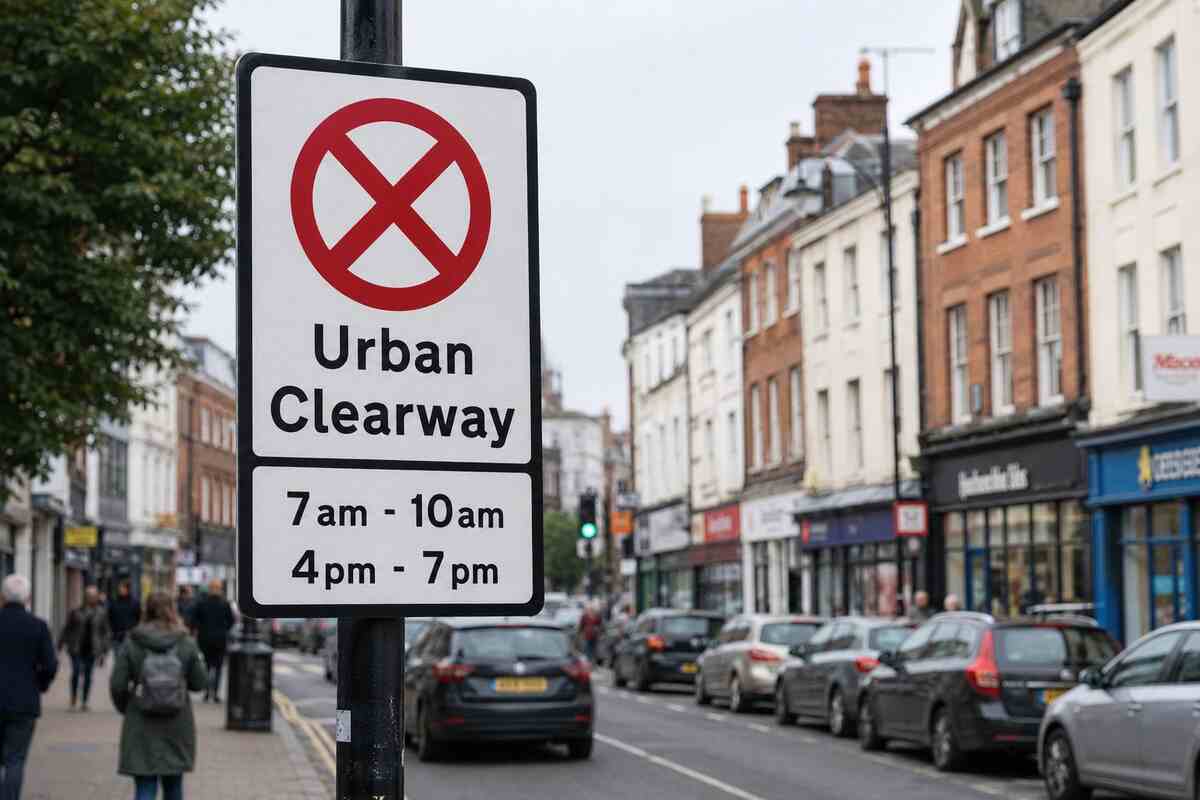
You’re driving through town, spot a space by the curb, and then you see it: a red circle sign reading “Urban Clearway” with a set of times printed underneath. Do those rules apply right now? Can you stop for two minutes? Is it different on weekends?
An urban clearway is a traffic restriction that only applies during set hours, and getting those hours wrong is a common way to pick up an unexpected fine. This guide explains what one is, when the restrictions apply, how to read the signs, and what happens if you get it wrong.
What Is an Urban Clearway?
An urban clearway is a section of road, usually in a town or built-up area, where stopping, waiting, or parking is banned during specific times of day. This restriction is enforced under Highway Code Rule 240, which sets out where drivers must not stop or park. Outside those hours, normal parking rules for that road usually apply.
Unlike a standard “no stopping” zone that applies around the clock, this restriction is time-restricted by design. Councils use it on busy routes to keep traffic flowing during peak periods, typically the morning and evening rush, without banning parking on that street entirely.
A road might be fine to park on at 11am on a Tuesday but off-limits at 8am the same day. The restriction is tied to the clock, not the road itself.
How to Identify an Urban Clearway Sign
This kind of sign typically includes:
- A red circle with a diagonal line, similar to a standard “no stopping” sign
- The words “Urban Clearway” printed above or below the symbol
- Time ranges listed underneath, for example 7am–10am and 4pm–7pm
- In some cases, specific days of the week
These signs are usually placed at the start of the restricted stretch and sometimes repeated along the route. If you only catch the red symbol without reading the times, it’s easy to assume the restriction is permanent when it isn’t, or the reverse.
If you’re unsure, treat the sign as active until you’ve had a proper look.
Typical Urban Clearway Restriction Hours
Every clearway is set locally, but some patterns show up repeatedly across UK towns and cities:
- 7am to 10am, covering the morning commute
- 4pm to 7pm, covering the evening rush
- Monday to Friday only, with weekends often unrestricted
- Occasionally a longer single block, such as 7am to 7pm on busier routes
These are common patterns, not fixed rules. The only times that legally apply are the ones printed on the sign in front of you. Two clearways in the same city can have different hours depending on how busy each route gets.
How to Check the Exact Restriction Times
Since hours vary street by street, the sign itself is the final authority, not what a nearby road does or what you remember from last time.
A few habits help here:
- Slow down enough to read the full sign, not just the symbol
- Check for more than one time range, since many clearways have both a morning and evening slot
- Look for day restrictions, as some only apply on weekdays
- Watch for temporary signage added around roadworks or local events
If you drive the same route often, it’s worth learning the exact times once rather than relying on a rough guess.
What Happens Outside the Restricted Hours?
Outside the listed hours, the restriction generally lifts and normal parking rules apply to that road.
That might mean:
- Free parking is allowed
- A pay-and-display or permit system applies
- Loading restrictions still apply separately, even once clearway hours have ended
Restrictions lifting doesn’t mean the road is free of all rules. Check for yellow lines, loading bay markings, or resident permit signs, since these can apply independently of clearway timing.
Can You Stop or Park Before Restrictions Begin?
Parking before the restricted hours start is fine if no other restriction applies. The issue is what happens next.
If your car is still parked there when the clearway restriction begins, you’re in breach, even if you parked legally beforehand. The rule applies to the time your vehicle is present, not the time you arrived.
If a clearway starts at 4pm and you park at 3:55pm for a twenty-minute errand, you’re likely to come back to a penalty notice. Build in a buffer around the start time rather than cutting it close.
Urban Clearway vs Clearway: What’s the Difference?
These terms sound similar, which is exactly why they get confused, but the timing difference is significant.
| Feature | Clearway | Urban Clearway |
| Location | Usually rural or non-built-up roads | Town and city roads |
| Restriction hours | Often applies 24/7 | Applies during set time windows only |
| Stopping allowed | Rarely, at any time | Yes, outside restricted hours |
| Sign appearance | Similar red circle symbol | Same symbol, plus printed time ranges |
A standard clearway generally means no stopping at any time. An urban clearway means no stopping, but only during the listed hours. Treating an urban clearway like a full clearway just costs you a legal parking spot. Treating a full clearway like it has flexible hours can cost you a fine.
What Counts as a Genuine Emergency Stop?
These rules allow for genuine emergencies, though the exception is narrower than most drivers assume.
Accepted reasons include:
- A mechanical breakdown that makes it unsafe to continue driving
- Avoiding an accident or sudden obstruction
- Complying with police or traffic officer instructions
What doesn’t count:
- Answering a phone call
- Checking directions or a sat nav
- A quick errand
- Waiting for a passenger
If you do need to stop for a genuine emergency, move as far off the main carriageway as possible and switch on your hazard lights.
Fines and Penalties for Ignoring Restricted Hours
Getting the timing wrong carries a real financial cost, and enforcement is often stricter than drivers expect.
Typical consequences include:
- A Penalty Charge Notice (PCN), usually issued by the local council
- Fines commonly ranging from around £60 to £130, depending on the area and how quickly it’s paid
- CCTV and camera enforcement, which is increasingly common on busy clearway routes, meaning no traffic warden needs to be present
- Vehicle removal in some cases, particularly if the stop causes a significant obstruction during peak hours
Many of these zones are monitored by camera rather than in-person patrols, so a quick, unnoticed stop is exactly what the system is designed to catch.
Tips to Avoid Getting Caught Out by Clearway Times
- Read the full sign, including every time range, not just the symbol
- Build in a buffer and avoid parking right up against a restriction start time
- Use a parking app or council website if you’re unsure about a specific road
- Don’t assume consistency, as nearby streets can have different clearway hours
- Check separately for loading restrictions, which may apply outside clearway hours
- When in doubt, find alternative parking rather than risk a short stop
FAQs
Does the restriction apply on weekends?
Not always. Many urban clearways only operate Monday to Friday, but this varies by location, so check the days listed on the sign.
Can I drop someone off during restricted hours?
Generally no. A brief stop to drop off a passenger is treated the same as parking, unless it’s a genuine emergency.
Is an urban clearway the same as a red route?
No. Red routes are a separate enforcement system used mainly in London, while urban clearways are time-restricted stopping areas found more broadly across UK towns and cities.
What if there’s no sign showing the exact times?
If the sign is unclear or missing time information, avoid stopping and report the missing signage to the local council.
Do the rules apply to motorbikes and cyclists?
Motorbikes are generally subject to the same restrictions as cars. Cyclists are typically exempt, though this can vary by location.
Can I get a refund on a fine if I misread the sign?
Misreading a sign usually isn’t grounds for an automatic refund, though you can appeal a PCN through the issuing council if the signage was unclear.
Conclusion
Urban clearway restrictions exist to keep busy roads moving during the times they’re needed most. Since the hours change from street to street, it’s easy to get caught by a rule you didn’t realise applied at that moment.
The safest approach is to read the full sign, note both the time ranges and the days, and build in a buffer rather than cutting it close. Once you understand how urban clearway timing works, reading these signs becomes second nature.