Plenty of pilots and cabin crew live in Britain while flying for carriers in Dubai, Doha or Madrid. Their salaries arrive in dirhams or euros, so they often assume the paperwork belongs to the airline’s country. It usually doesn’t.
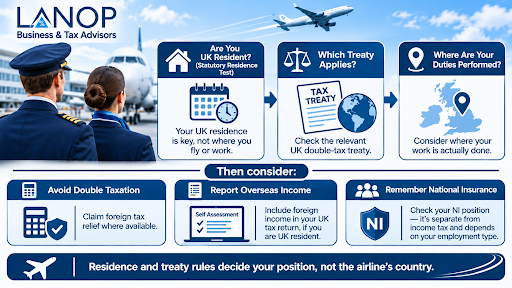
Good airline accounting starts with one question: are you still a UK taxpayer? The answer depends on your residence status, the relevant tax treaty and where your duties actually happen, not on where your employer’s head office sits.
Does Working for a Foreign Airline Mean You Stop Paying UK Tax?
Not necessarily. If you are a UK resident during a tax year, you will generally pay tax on your world wide income to HMRC. First establish if you are a resident and then consider any treaties and foreign payrolls.
Many crew members will assume that if you have foreign payslips you will be paying tax abroad – often this is where expensive errors occur.
How Does Your Employer’s Country Change the Picture?
The treaty you need depends on where you work and where you live. Here’s a simplified view:
| Situation | Pay currency | Starting point |
| UK resident flying for Emirates | AED | Check UK residence, then the UK-UAE treaty |
| UK resident flying for Qatar Airways | QAR | Check UK residence, then the UK-Qatar treaty |
| UK resident flying for a European carrier | EUR | Check UK residence, then the relevant treaty |
Each treaty uses different aircrew wording, so treat the table as a checklist rather than a verdict.
The Statutory Residence Test: Why Time Abroad Isn’t Enough?
Just because you spend most of the year outside the UK you do not automatically qualify as a non-resident. Whether you are a UK resident depends on the Statutory Residence Test (SRT). The automatic abroad tests could make you a non-resident whilst the automatic UK tests could mean you’re a resident. If you don’t qualify for either the ‘sufficient ties’ test will apply. This looks at how many family, accommodation, work and days in the UK you have.
Aircrew receive special treatment. If your job qualifies as a relevant job you may be treated differently under the SRT if you spend a high percentage of your working days undertaking qualifying cross border travel.
This should be around 80% however please check HMRC guidelines for your situation. If you complete 6 or more qualifying journeys in a year you may not qualify for the third automatic tests. The ‘sufficient ties’ test will then apply. Your flight logs will be important.
Does the 183-Day Rule Apply to Pilots?
Not necessarily some treaties have a separate provision which allows for employees to be away from the UK for less than 183 days. However, it is still important to note that a flight schedule will not provide any evidence of this.
The method of calculating days can be more complex than would be expected. Normally you will count a day if you are present in the UK at midnight however there are exceptions to this. You will not automatically gain a day if you leave/arrive.
How Do Double Taxation Treaties Change the Outcome?
Double Taxation Agreements (DTAs) will determine which country is entitled to tax certain incomes and will provide relief to tax the same earnings in both countries. Some treaties include specific provisions for individuals working on aircraft. Other treaties will look at where the business is based.
The UK-UAE treaty bases the determination of tax residence on the employee being “qualified aircrew”. The UK-Qatar treaty bases it on the business and the UK-Spain treaty looks primarily at the business’ tax residence. These should not be assumed when applying to employment in another country.
The registered office for an airline does not necessarily correlate to their tax residence. Many treaties will look at where key decisions are actually made the “place of effective management.” The contractor will need to be identified.
Where Your Duties Are Performed?
Flying in UK airspace does not give rise to a UK tax liability, however duties carried out in the UK may do. Pre-flight, post-flight and training activities may qualify. There are detailed rules relating to apportionment. Flight rotas, training records and duty rosters will determine where the work was actually undertaken.
Avoiding Double Taxation
Not all foreign payroll taxes will be used to clear your UK liability. You may be able to claim foreign tax credit relief to reduce your UK liability for the same income however there are limits:
| Description | Amount |
| Relevant overseas employment income | £80,000 |
| Illustrative UK tax on that income | £20,000 |
| Qualifying foreign tax paid | £8,000 |
| Potential foreign tax credit | £8,000 |
| Illustrative remaining UK tax | £12,000 |
This is a very simplified example. Whilst not everyone will be liable, not all deductions are available. If you have paid too much foreign tax then HMRC will not give you a refund. You may need to deal directly with the foreign tax authority.
Reporting Your Overseas Income
As a UK resident, overseas income will generally be included within your Self Assessment tax return. You can convert your AED/QAR/EUR income using a consistent and justifiable exchange rate. This should be evidenced.
Bonus, allowance, housing and pension payments should be accounted for. Some work related costs, like type rating or licence renewal, could be eligible. However nothing is automatically claimable. You should keep your payslips, contracts, foreign tax certificates, pension statements and flight logs. If your airline does not provide you with a P60 in the UK then you will need these documents to prove.
National Insurance Is a Separate Question
Income tax is not related to National Insurance. You will need to consider what type of employment you have, where your employer is based and social security agreements. Due to changes with the coordination rules (A1 certificate) relating to the EU after Brexit, you should check with HMRC or DWP to ensure that this is relevant.
Common Mistakes Pilots Make
The most expensive mistakes occur when making any of these assumptions:
- Working abroad means your a non-resident
- The 183 day rule is an assurance
- Where you are taxed will depend upon where the airline is based.
- You won’t have to declare because they are paying you abroad.
- Flying internationally means you qualify for relief under the Seafarers’ Earnings Deduction.This is relief for employment on board ships.
When Specialist Help Makes Sense
Residence reviews, treaty comparisons and payslip reconciliations can be a lengthy process and errors can be costly. Lanop’s pilot accounting team can go through these processes with your aircrew via our Accountants for Pilots service.
Frequently Asked Questions
How does the UK-UAE treaty affect me if I fly for Emirates?
The treaty allows for the allocation of tax between qualifying members of aircrew however you need to check the wording of the treaty to ensure that it applies to your current situation. You will also still be subject to UK laws.
Why doesn’t my foreign tax certificate match my UK return?
Foreign tax certificates are often raised in different periods, currencies and tax years. They can also differ due to exchange rates. To help you get things right, ensure you compare the numbers against your payslips and note the exchange rate you have used.
I changed airline/base during the year
If you have changed airline/base during the year you may have a split year. This means that your residency status will be different pre and post the change. Ensure to collect all payslips and certificates from the entire year and check your residency status.
How does having gaps in my UK employment affect my State Pension?
If you have periods where you were not working in the UK you may have gaps in your National Insurance contributions. You may be able to make voluntary contributions to fill some of these gaps however there are rules and time limits. The State Pension forecast on GOV.UK is a great place to start.
What documents should I keep in case HMRC investigates?
You should keep copies of your flight rosters, duty rosters, payslips, contracts, foreign tax certificates and bank statements showing salary received. Ideally keep these for at least 5 years after the relevant deadline.
Conclusion
Working for an overseas airline doesn’t remove your UK tax obligations, and it doesn’t automatically create them either. Residence rules and treaty provisions must be read together, and good records decide whether your position holds up. Strong airline accounting turns that picture into a position you can defend.
Lanop Business & Tax Advisors work with pilots and cabin crew to ensure your status is correct. It is important to get this right before the new tax year starts.