If your taps run weak, your shower feels underpowered, or one floor of your building always gets less pressure than the rest, the cause often isn’t your water supply. It’s the ppr size chosen when the system was installed.
PPR (Polypropylene Random Copolymer) pipes are a reliable choice for hot and cold water systems, but even good material underperforms if it’s the wrong diameter for the job. Sizing mistakes don’t announce themselves like a leak or a burst pipe would. They just quietly limit your water pressure for years, and most people assume it’s simply how the building is.
This guide covers how pipe sizing affects water pressure, the specific sizing mistakes that cause the most problems, and how to fix or avoid them, whether you’re troubleshooting an existing system or planning a new one.
What Causes Low Water Pressure in PPR Pipe Systems
Low water pressure usually comes down to one of three things: a supply-side issue with the utility or pump, a blockage, or a pipe network that wasn’t sized correctly for its demand.
Sizing issues are the easiest to overlook because they don’t show symptoms right away. A pipe that’s slightly too narrow will still deliver water, just not enough of it once a shower, a washing machine, and a kitchen tap are running at the same time. The system technically works, so nobody questions the pipe size until pressure complaints build up.
Other contributors include:
- Corroded fittings restricting flow (less common with PPR, but relevant in mixed-material systems)
- Too many bends or tees adding friction loss
- A pressure-reducing valve set too conservatively
- Long pipe runs without a matching increase in diameter
Most of these make an existing sizing problem worse rather than cause pressure loss on their own, which is why getting the pipe size right from the start matters so much.
How PPR Size Affects Water Flow and Pressure
Water pressure and pipe diameter have a direct relationship. The smaller the internal diameter, the more resistance water meets as it moves through the pipe. This resistance is called friction loss, and it increases sharply as pipes get narrower, not gradually.
A useful rule of thumb: doubling the flow rate through the same pipe roughly quadruples the friction loss. So even a small mismatch between your PPR size and actual demand can produce a noticeable pressure drop.
This is also why two homes with similar layouts can have very different water pressure. One was sized for peak demand, with multiple fixtures running together. The other was sized only for average, single-fixture use.
Choosing an Undersized PPR Pipe Diameter
This is the single biggest cause of chronic low pressure. It usually happens for one of two reasons: cost-cutting during construction, or underestimating how much water the household or building actually uses at once.
A 20mm pipe works fine for a single bathroom with light use. Run that same 20mm line as a main supply feeding a kitchen, two bathrooms, and a washing machine, and you’ll feel it the moment more than one fixture runs at once.
Typical undersizing scenarios:
- Using branch-line sizing (20mm) on a main supply line that should be 32mm or larger
- Sizing for current fixtures without accounting for reasonably likely future additions
- Copying a “standard” pipe size from another project without checking actual flow demand
If pressure has been weak since day one, undersizing is the first thing worth checking.
Why Oversized Pipes Can Also Hurt Performance
It’s tempting to assume bigger is always better, but oversizing creates its own problems, just less obvious ones than undersizing.
When a pipe is too large for the flow passing through it, water moves more slowly. That can lead to:
- Sediment settling inside the pipe over time, gradually narrowing the effective diameter
- Increased heat loss in hot water lines, since water sits in the pipe longer before reaching the tap
- Higher material and installation costs without any real performance benefit
Oversizing rarely causes low pressure directly, but it is a wasted investment. In hot water systems, it can also make water take noticeably longer to run hot, which people often mistake for a pressure problem.
Mixing Pipe Diameters: A Hidden Cause of Pressure Drops
Even when the main pipe size is correct, problems often show up at transition points, where a larger pipe reduces to a smaller one or a mismatched fitting joins two different diameters.
Every reduction in pipe size creates some resistance, and that’s normal since a main line has to branch into smaller supply lines eventually. The mistake happens when:
- The reduction is too abrupt, such as jumping from 32mm straight to 16mm instead of stepping down gradually
- Reducers or fittings aren’t properly matched to both pipe sizes
- Multiple high-demand fixtures are fed from a branch sized for just one
If pressure is fine at the main line but drops at specific fixtures, check the sizing at that branch. The problem is usually localized, not systemic.
Ignoring Flow Rate Requirements When Sizing Pipes
Many sizing decisions are made based on pipe diameter alone, without calculating the actual flow rate (in liters or gallons per minute) the system needs to deliver.
Flow rate depends on:
- The number of fixtures that might run simultaneously
- The flow demand of each fixture, since a power shower needs more than a standard tap
- Peak usage times, such as a morning routine when several people use water at once
For example, if your household regularly runs a shower while the kitchen tap and washing machine are also active, your pipe needs to handle that combined demand, not just whichever fixture uses the most water on its own.
Skipping this calculation is one of the most common reasons homeowners get adequate pressure at a single tap but frustrating drops the moment a second fixture turns on.
How Pipe Length and Layout Impact Water Pressure
Pipe diameter isn’t the only factor. How far water has to travel, and how many turns it takes to get there, both add resistance along the way.
- Longer runs need a larger diameter to maintain the same pressure at the far end. A size that works fine for a 5-meter run may fall short over 20 meters.
- Bends and elbows each add some friction loss. A layout with many tight turns needs slightly larger pipes than a straighter one to deliver the same pressure.
- Vertical rises in multi-story buildings add elevation-related pressure loss on top of friction loss, which is why upper floors often need adjusted sizing or pressure-boosting solutions.
Most published PPR size charts assume short, straight runs. Real installations rarely match that exactly, so it’s worth building in a margin for length and layout.
PN Rating and Wall Thickness
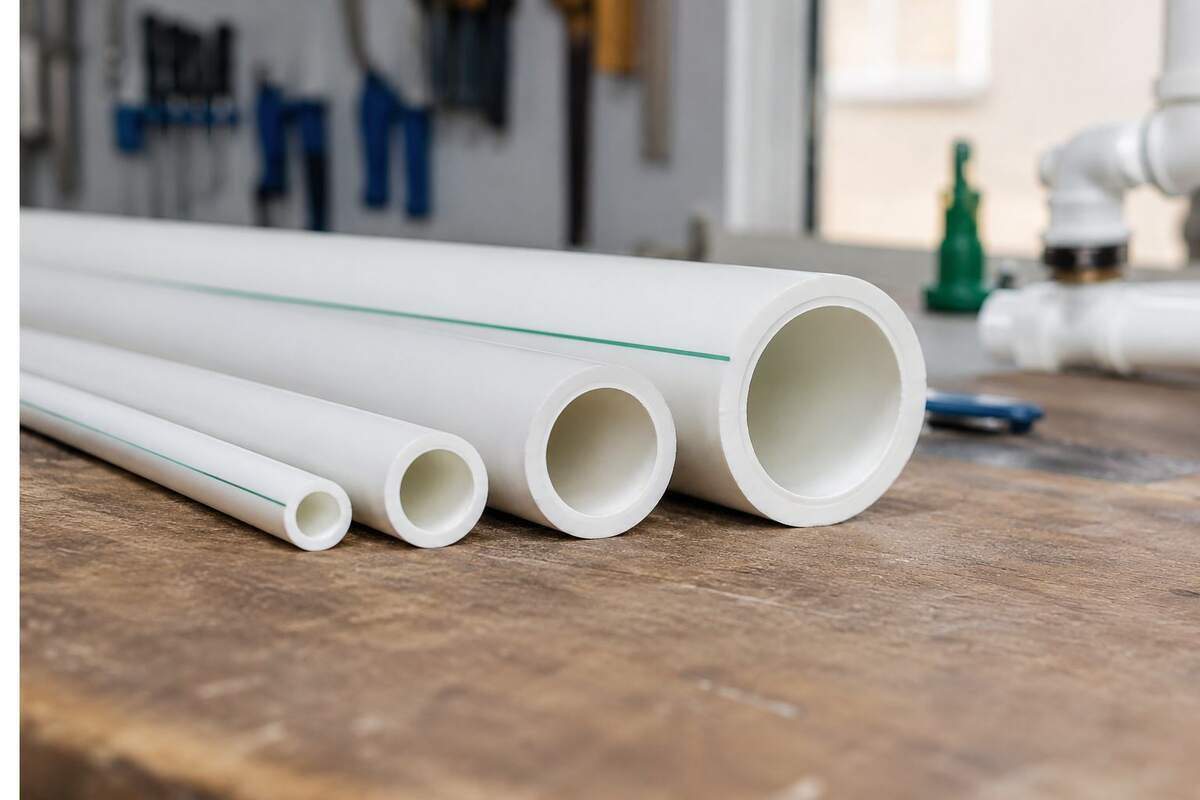
Pipe size isn’t just about outer diameter. It’s paired with a pressure rating (PN) that determines wall thickness, and by extension, how much internal diameter is left for water to flow through.
Two pipes with the same nominal outer size can have different internal diameters depending on PN rating:
- PN10 / PN12.5: thinner walls, suited to lower-pressure cold water applications
- PN16: a common middle ground for general residential use
- PN20 / PN25: thicker walls for high-pressure or hot water systems
A higher PN rating means thicker walls, which slightly reduces internal diameter compared to a lower-rated pipe of the same nominal size. In systems where every millimeter of flow counts, choosing an unnecessarily high PN rating can work against you: more pressure resistance capacity, but marginally less room for water to move.
How to Choose the Right PPR Size for Your Home
Getting sizing right isn’t complicated once you follow a clear process:
- List every fixture the pipe run will serve, including future additions you’re reasonably confident about.
- Estimate peak simultaneous demand, not just the total number of fixtures, but how many run at once in practice.
- Match diameter to demand using a manufacturer’s flow chart as a starting point rather than a final answer.
- Account for length and layout, adding a margin for long runs or layouts with many fittings.
- Choose the right PN rating based on whether the line carries hot or cold water and the pressure it needs to handle.
- Avoid abrupt size reductions, stepping down gradually where branch lines split from the main supply.
As a general reference, many residential systems use 20 to 25mm for branch lines and 32mm or larger for main supply lines. Treat this as a starting benchmark, not a fixed rule. Actual demand should always guide the final decision.
Signs Your PPR Pipe Sizing Needs to Be Fixed
You don’t need to guess. These signs point to sizing, not your water supply, as the root cause:
- Pressure drops noticeably whenever a second fixture is used
- Upper floors or far-end fixtures consistently have weaker pressure than the rest of the system
- Hot water takes unusually long to arrive at distant taps
- Pressure has been weak since installation rather than gradually worsening (which points more toward blockage or corrosion)
- A recent renovation added fixtures without any corresponding pipe upgrade
If several of these apply, have a plumber check pipe diameters against actual system demand before assuming the problem lies elsewhere.
Tips to Avoid Sizing Mistakes in Future Installations
- Don’t rely on what was used last time. Every layout and fixture count is different, so copy the calculation process, not the exact size.
- Plan for future demand, not just what’s installed on day one. Adding a bathroom later almost always means resizing pipework you’d rather not touch again.
- Use verified manufacturer charts, and for anything beyond a simple residential layout, get a second opinion from a plumber or engineer.
- Document your sizing decisions. Future renovations go smoother when the original reasoning is on record.
- Test under real conditions where possible, running multiple fixtures together rather than testing them one at a time.
FAQs
What is the best PPR size for a residential water supply line?
For most homes, 25mm to 32mm works well for main supply lines, with 20mm commonly used for branch lines. The right choice still depends on total fixture count and peak simultaneous demand.
Can the wrong PPR pipe size really cause low water pressure?
Yes. An undersized pipe restricts flow and creates friction loss, which shows up as weak pressure, especially when more than one fixture is used at the same time.
Does a bigger PPR pipe always mean better water pressure?
Not necessarily. Oversized pipes can slow water movement, encourage sediment buildup, and increase heat loss in hot water lines without improving pressure.
How do I know if my current PPR size is too small?
If pressure drops noticeably when a second fixture runs, or if it’s been weak since installation rather than gradually worsening, sizing is a likely cause.
Does pipe length affect what PPR size I should use?
Yes. Longer runs experience more friction loss, so they generally need a larger diameter than shorter runs to maintain the same pressure at the fixture.
Is PN rating related to pipe size?
Yes. A higher PN rating means thicker pipe walls, which slightly reduces the internal diameter available for water flow, even if the outer size stays the same.
Conclusion
Low water pressure is frustrating, but it’s rarely a mystery once you know where to look. In most cases, the real issue traces back to ppr size: a pipe undersized for actual demand, sized without accounting for length and layout, or mismatched at a transition point where diameters change.
The fix isn’t complicated. Calculate real flow demand, size pipes accordingly, account for your layout, and avoid guessing based on what seemed standard elsewhere. Get the sizing right from the start, and you’ll avoid years of weak showers, slow-filling washing machines, and pressure complaints that never quite go away.