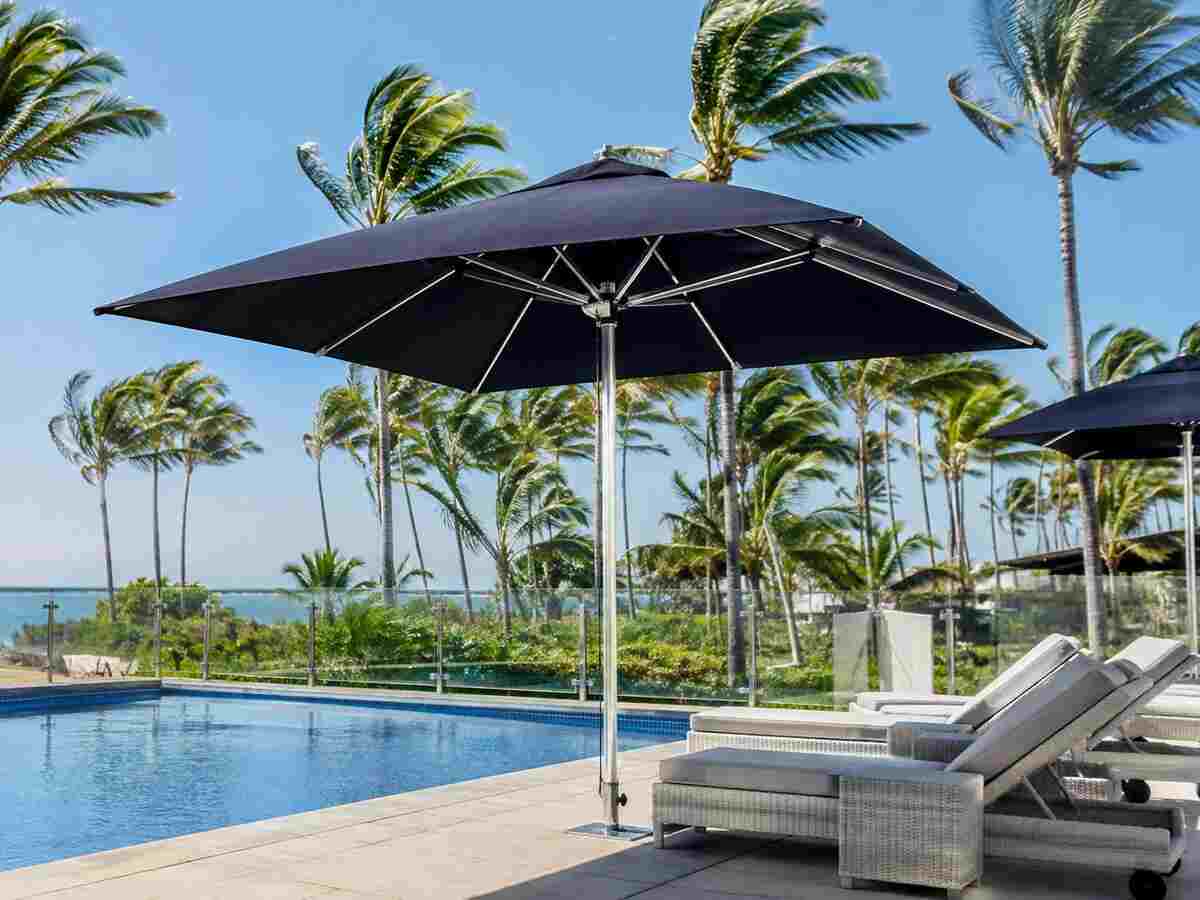
If you’ve ever sat under a market umbrella that started shaking the moment the wind picked up, you already understand the problem. Ausbrella is an Australian-made outdoor umbrella designed to stay upright in conditions that would damage a standard umbrella. You’ll find it at resorts, cafes, and poolside areas across the country, and if you’ve spotted one and wondered what makes it different, this guide covers exactly that.
Below, you’ll learn where Ausbrella came from, how its engineering works, what its wind ratings actually mean, and whether it’s a good fit for your own outdoor space.
What Is Ausbrella and Where Did It Come From?
Ausbrella is a brand created by Awnet, one of Australia’s largest manufacturers of commercial market umbrellas and cafe barriers. It came from a common problem: standard umbrellas don’t hold up well to Australia’s coastal and inland winds.
Instead of adjusting an existing design, Awnet’s founder rebuilt the outdoor umbrella from the ground up, focused on durability and long-term performance rather than shade for calm days only.
The Engineering Behind Ausbrella’s Strength
Every outdoor umbrella has a wind limit. For most, that limit is a moderate gust. Ausbrella was designed to handle far more, which meant reworking the frame, pole, fabric mounting, and opening mechanism from scratch.
Twin-Skin Pole Technology
The core of Ausbrella’s strength comes from its pole design. Instead of a single aluminium shaft, it uses a twin-skin pole, essentially a pole within a pole, which adds rigidity without extra weight.
This layered construction spreads stress more evenly through the frame during high winds, reducing the flex that causes standard umbrellas to bend or snap. It’s a patented design and the main reason Ausbrella can carry wind ratings most outdoor umbrellas can’t match.
Other design details include:
- Bolt-on fabric covers, more secure than Velcro or clip systems
- A rope-free opening mechanism, removing a common failure point
- Engineer certification for every unit, rather than just a manufacturer’s claim
Understanding the Wind Ratings
Wind ratings get the most attention, and they’re worth understanding properly.
The Storm range is rated to 140kph, already well beyond what a typical market umbrella survives. Most standard umbrellas start failing somewhere between 40 and 60kph.
The Hurricane 160+ range goes further, tested beyond 160kph. These ratings were tested at Monash University’s Mechanical and Aerospace Wind Tunnel Facility, according to the manufacturer, with additional assessment from an independent engineering firm.
This matters most if you’re in a storm-prone or coastal area, where a lower-rated umbrella becomes a safety risk rather than just an inconvenience.
Storm vs Hurricane 160+: Which One Fits Your Space
Both ranges share the same core engineering but suit different exposure levels.
Storm range
- Wind rated to 140kph
- Suited to suburban and semi-sheltered areas
- A strong upgrade over standard umbrellas at a lower price point than the Hurricane range
Hurricane 160+ range
- Wind rated beyond 160kph
- Uses a double twin-skin pole for added rigidity
- Built for high-exposure locations, including open coastal resorts and areas with frequent severe weather
If your space is relatively sheltered, the Storm range is usually enough. If you’re dealing with an exposed site or frequent strong winds, the Hurricane 160+ is the safer long-term choice.
Materials and Build Quality
Ausbrella’s build quality shows up in details most buyers don’t consider until something breaks.
The frame uses an interlock system that spreads pressure across joints instead of concentrating it at one point, a common weak spot in cheaper umbrellas. The fabric is bolted on rather than stretched over the frame, reducing flapping and tearing in wind. A matching in-ground stainless steel socket keeps the base secure instead of relying on a loose stand.
Each unit also comes with an engineer’s certificate, useful for commercial buyers who need documentation for insurance, council approval, or workplace safety compliance.
Where Ausbrella Umbrellas Are Commonly Used
Ausbrella shows up most often in settings where damage or downtime isn’t an option:
- Beachside and coastal resorts
- Hotel pool areas and outdoor dining spaces
- Council parks and public open areas
- Cafes and restaurants with outdoor seating
- High-profile events, including outdoor bar and dining areas at the Australian Open
The common thread is exposure to unpredictable weather, combined with a need for the umbrella to keep working and looking good day after day.
Warranty and Local Support
Ausbrella comes with a 5-year manufacturer’s warranty, well above what most standard market umbrellas offer. Because it’s made in Australia, warranty claims and support are handled locally rather than through an overseas supplier.
For commercial buyers, that local manufacturing and quick warranty response often matters as much as the wind rating itself.
Is a Wind-Rated Umbrella Worth It for You?
A wind-rated umbrella isn’t necessary for every backyard, but it’s worth considering if any of these apply to you:
- You live in a coastal, elevated, or storm-prone area
- You’re outfitting a commercial space where umbrella failure means lost business or safety risk
- You’ve already replaced a standard umbrella after wind damage
- You want a long-term fixture rather than a seasonal replacement
If your area is sheltered and low-wind, a standard umbrella may still be fine. But if you’ve already dealt with a bent pole or torn canopy after one bad afternoon, the case for a stronger option is easy to see.
Ausbrella vs Standard Umbrellas at a Glance
| Feature | Standard Umbrella | Ausbrella |
| Pole design | Single-wall aluminium | Twin-skin (or double twin-skin) |
| Wind rating | 40 to 60kph | 140 to 160+kph |
| Fabric attachment | Velcro or clips | Bolt-on system |
| Opening mechanism | Ropes and pulleys | Rope-free |
| Certification | Rarely provided | Engineer-certified |
| Warranty | 1 to 2 years | 5 years |
The trade-off is price. Ausbrella sits at a premium compared to entry-level umbrellas, but for anyone factoring in replacement costs or safety risk, that upfront cost often pays off over time.
FAQs
Is Ausbrella really the strongest umbrella in the world?
Its wind tunnel testing to 160+kph is independently verified, which is rare for outdoor umbrellas. Whether it’s technically the strongest in the world is hard to confirm against every competitor, but its ratings are well above the industry standard.
How much does an Ausbrella umbrella cost?
Pricing depends on size, shape, and wind rating. As a premium, certified product, it costs more than a standard market umbrella. Contacting Awnet directly is the most accurate way to get pricing for your specific setup.
Can Ausbrella be used at home, or only commercially?
Both. It’s common at resorts and hospitality venues, but also suits residential settings, especially around pools or exposed outdoor areas.
What shapes are available?
Ausbrella umbrellas typically come in square or octagonal shapes, depending on the model.
Should the umbrella stay open during a storm because of its wind rating?
No. A wind rating reflects engineered resilience, not a recommendation to leave any umbrella open in severe weather. It’s still best practice to close outdoor umbrellas in extreme conditions.
Conclusion
Ausbrella is a purpose-built umbrella engineered for Australia’s demanding weather, not just a product with a bold claim attached to it. Its twin-skin pole, verified wind ratings, and 5-year warranty all point to the same goal: durability that outlasts a standard umbrella by years, not seasons.
Whether you’re setting up a resort, a cafe, or your own backyard, understanding what sets Ausbrella apart makes it easier to decide if the investment fits your space. If wind exposure is a real factor where you live, it’s worth serious consideration.