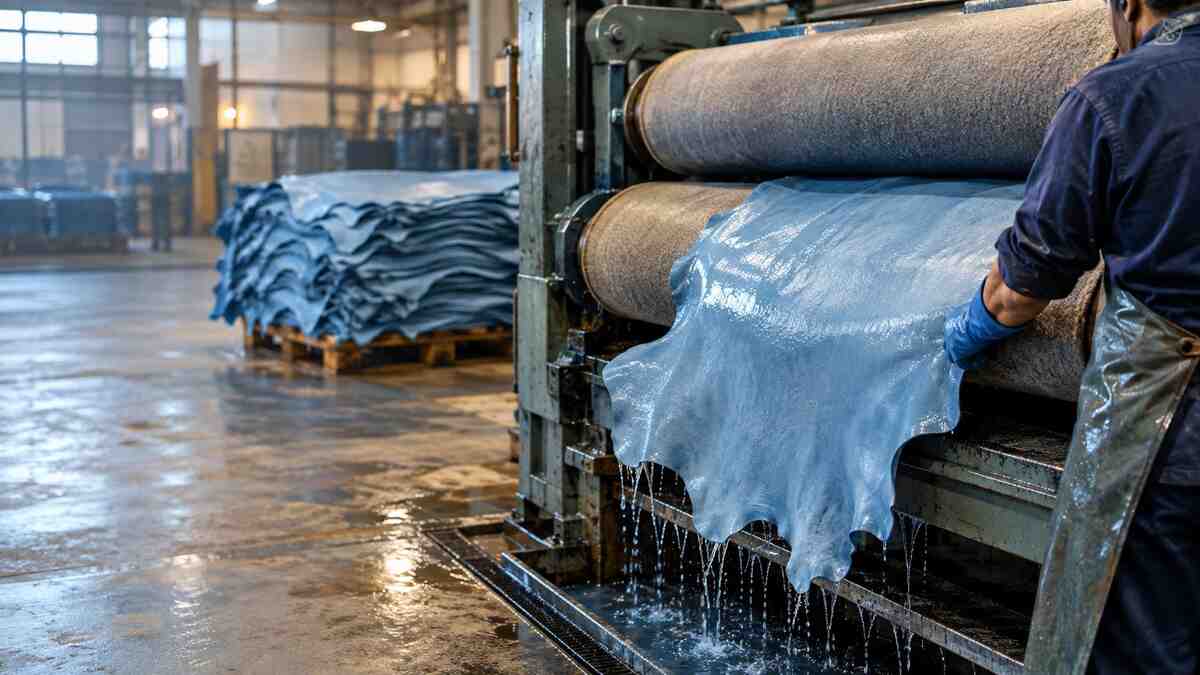
A hide fresh out of the tanning drum is heavy, saturated and nowhere near ready to become a belt, bag or boot. Most of that water has to come out before shaving, dyeing or softening can begin. Sammying is the step that does it.
The word sounds odd, and its meaning depends on who you ask. This guide explains what sammying is, where the term comes from, how the process works and what separates a good result from a poor one.
What Is Sammying in Leather Making and Tanning?
In a modern tannery, sammying is a mechanical step that presses water out of wet leather after tanning. After chrome tanning, hides are wrung (or “sammied”) to remove excess water. This is also called dewatering, and it’s needed because tanning liquors and water baths leave the hide saturated.
It removes a lot. According to Wikipedia’s guide to leather production processes, the step squeezes out roughly 45 to 55% of the water in the leather. It comes early in the post-tanning sequence, before shaving, retanning and setting.
Think of wringing out a soaked towel before hanging it up. You aren’t drying the leather yet, only removing the bulk of the water so the next steps work properly.
Sammying Meaning and Where the Term Comes From
The word has an older, dialect root. Merriam-Webster lists sammy as a verb meaning to moisten leather before staking, or to make rough-tanned leather evenly moist throughout. It traces the verb to sam, and notes that the dialect adjective sammy means clammy, sodden or watery. Wiktionary gives a similar sense: to moisten animal skins with water.
So the older dictionary meaning is about dampness, while the modern factory meaning is about removing surplus water. Both come down to getting leather to the right moisture level for the next job. In an old craft text, “sammying” may mean dampening. In a modern tannery or a machinery catalogue, it almost always means squeezing water out.
Wringing, Dewatering and Setting Out: Related Terms
Tannery vocabulary overlaps, which confuses newcomers. Here is how the main terms relate:
- Sammying: pressing water out of wet leather between rollers.
- Wringing or dewatering: the same idea in plainer language.
- Setting out: a related machine step that removes water and also flattens the leather, giving it area and grain flatness.
- Samm/set machines: combined machines that do both jobs, which is why the two steps are often written together.
- Conditioning: the opposite step, where water is added back to a controlled level later in production.
- Staking: mechanically working dried leather to soften it.
Why Tanners Remove Water After Tanning
A saturated hide is hard to work with. Removing most of the water first does three useful things:
- Prepares the leather for later steps. Shaving, splitting and retanning follow this step in a typical sequence, and leather that is still sopping wet doesn’t handle them well.
- Saves drying time and energy. Pressing water out mechanically costs far less than evaporating it later.
- Smooths and aligns the hide. The machine also removes wrinkles and positions the hide for even drying.
There is a commercial reason too. Wet-blue hides, which are chrome-tanned and sold semi-finished, are often shipped after this step, and a drier hide weighs less to transport.
How Moisture Levels Change From Wet Blue to Finished Leather
Leather doesn’t go from wet to dry in one move. Its water content rises and falls through production:
- Right after tanning: saturated with liquor and water.
- After water removal: a large share of the liquor is pressed out.
- During retanning and dyeing: wet processing adds water again.
- After drying: water content sits at about 10 to 20%.
- At conditioning: water is added back to a level of 18 to 28% so the leather can be softened properly.
This is why both “moisten” and “squeeze out” appear in the history of the word. Leather has to pass through the right moisture window at every stage.
How the Process Works in a Tannery, Step by Step
Details vary by machine and leather type, but the flow usually looks like this:
- Hides come out of the drum. After tanning, they are drained and often stacked.
- Hides are fed into the machine. They are laid flat so wrinkles aren’t pressed in.
- Felt-covered rollers squeeze the leather. Machine makers describe the hide being pressed by felt cylinders to remove excess water.
- Water drains away. Felts and belts must carry off a large volume of water, so drainage is built into the machine design.
- Hides leave flatter and much drier. They move on to shaving, splitting or retanning.
On some machines, wet-blue hides can be split immediately afterwards.
Machines Used for Water Removal and Setting Out
Water removal is mostly a machine job, and the core design is simple. A sammying machine has two rollers, one hard and one soft, that squeeze water out as the hide passes through.
Common types include:
- Alternating (two-action) machines: the hide is pressed in a back-and-forth cycle.
- Continuous (single-action) machines: hides pass through in a single run.
- Three-roller and five-roller through-feed machines: one manufacturer’s five-roller model applies more pressure and suits tanners who want drier wet-blue hides. Its three-roller model applies less pressure and suits tanners who plan to retan afterwards.
Small, traditional workshops dewater hides as well. A study of artisanal leather making in Ghana notes that excess water is removed mechanically at this stage.
How Much Water Comes Out? Signs of a Good Result
The benchmark from process literature is about half the water content, as noted above. In practice, tanners judge the result by looking at and handling the leather.
Signs of a good result:
- Hides feel evenly damp, not dripping or patchy.
- The surface is flat, with no deep pressed-in creases.
- Area and thickness look consistent across the hide.
Precision pays off at scale. One machinery maker claims that better spreading and moisture removal can add around 2.5 to 3.0% extra area yield on a typical wet-blue hide. That is a manufacturer’s claim, but it shows why small gains matter.
Common Mistakes and How to Avoid Them
These issues come up in practice. Check the specifics against your own equipment and leather type:
- Feeding hides in wrinkled. Creases pressed in at this stage can stay. Spread hides flat before they enter the machine.
- Using the wrong pressure. Too little leaves leather soggy. Too much can cause problems if you plan to retan afterwards, which is why machines are chosen to suit the next step.
- Letting felts wear out or clog. Felts do the water-carrying work, so tired felts mean poor moisture removal.
- Treating all leather the same. Hide thickness, tannage and the next process all change what “done” looks like.
- Mixing up the stages. This step removes water, while conditioning adds it back. Confusing them leaves leather too wet or too dry.
FAQs
What does sammying mean in leather making?
It is the step where excess water is mechanically pressed out of freshly tanned leather, usually between rollers.
Is water removal the same as drying?
No. It removes the bulk of the water mechanically, but the leather still needs proper drying afterwards.
What is a sammying machine?
A machine with pressing rollers, often felt-covered, that squeezes water out of hides as they pass through.
How much water does sammying remove?
One process overview puts it at about 45 to 55% of the water content.
Why do some dictionaries say the word means moistening?
The older dialect sense relates to dampening leather before staking. Modern tanneries mostly use the word for water removal.
What is the difference between wringing and setting out?
Setting out also removes water but adds flattening and area control. Many machines combine the two.
Conclusion
Sammying is a small-sounding step that does a lot of work. It turns a saturated hide into something ready for shaving, retanning and setting, while smoothing and aligning it along the way. The word’s older meaning is about dampness, but in a modern tannery it means removing water at the right moment.
The main takeaway is that good leather depends on managing moisture at every stage, and this step is where that control starts.