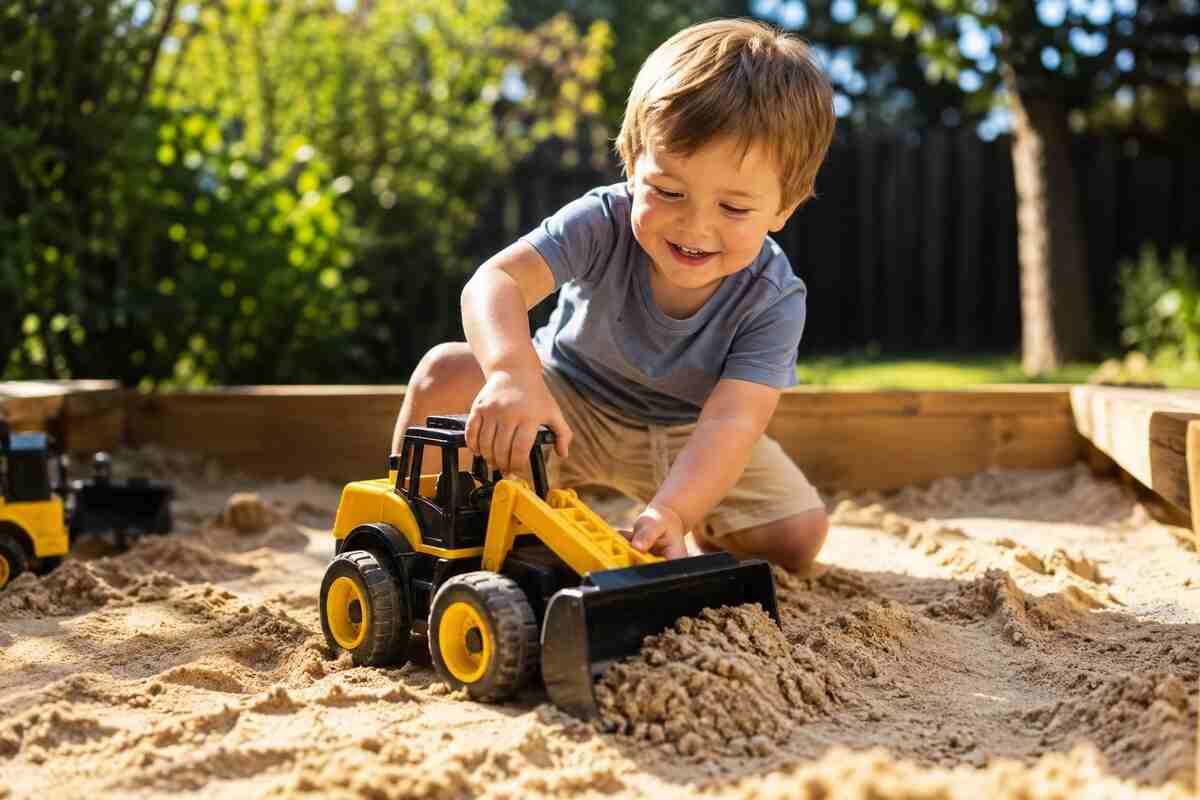
Watch a toddler push a toy loader through a sandbox for twenty minutes straight, and you’ll understand why the Sandlader is one of the most popular sand toys around. It doesn’t light up or make noise. It just gives kids something satisfying to scoop, push, and dump.
If you’re shopping for one, you’ve likely noticed the age labels don’t always agree. Some packaging says 18 months, other listings say 3+, and reviews add to the confusion. This guide clears that up with a straightforward answer based on how these toys are actually built and used.
You’ll learn which age groups get the most out of a Sandlader, what safety details matter at each stage, how material affects durability, and how to choose the right size for your child.
What Is a Sandlader and How Do Kids Use It?
A Sandlader is a scaled-down sand loader, a toy vehicle designed to scoop, carry, and dump sand, similar to the construction equipment it’s modeled after. Most versions have a front-mounted scoop, rubber or plastic wheels, and a frame built for outdoor play.
Kids push the loader through loose sand to fill the scoop, then dump it elsewhere or use it to shape small hills and roads. Some models tip automatically; others require a manual pour.
Compared to a basic bucket and shovel, a Sandlader adds mechanical interaction: pushing, steering, scooping. That extra layer of “real tool” play is a big reason it holds attention longer than simpler sand toys.
Sandlader Age Recommendations: A Quick Overview
Here’s the short version, based on how most manufacturers design and test these toys:
- 18 months to 2 years – Simplified, oversized models with no small or removable parts
- 3 to 5 years – The sweet spot; most Sandlader designs target this range
- 6 years and up – Kids often move on to more complex vehicles, though many still enjoy a Sandlader for casual play
Most products on the market are built specifically for the 3–5 age range. That’s when kids have the motor control to scoop and dump sand purposefully, but are still young enough to enjoy the repetitive, hands-on play. Models labeled for toddlers under 2 are usually simplified to remove choking hazards and reduce overall complexity.
Is It Safe for Toddlers Under 2 Years Old?
Read the product details closely here, not just the age sticker.
A Sandlader marketed for toddlers under 2 should include:
- No small, detachable pieces such as wheels or axles that can pop off
- Rounded edges with no sharp corners
- A low center of gravity so it doesn’t tip easily
- Non-toxic, food-grade plastic or a sealed wood finish
Even with those features in place, close supervision is still recommended for this age group. It’s less about the toy itself and more about toddlers this young still mouthing objects and having unreliable balance while pushing a wheeled toy across uneven ground.
If you’re shopping for a child under 2, look for “toddler-safe” or “18 months+” labeling specifically, rather than assuming a standard model will work. Most standard Sandlader toys are built for slightly older hands.
Best Age Range for Preschoolers (Ages 3–5)
This is where the Sandlader works best. By age 3, most kids have the hand-eye coordination and grip strength to operate the scoop on their own. By age 5, they’re often combining it with other sand toys for more elaborate setups.
A few reasons this age range fits so well:
- Kids can steer the loader with reasonable control while walking or crouching
- They understand cause and effect well enough to enjoy the scoop-and-dump cycle
- Sand play at this age supports early problem-solving, like figuring out how to keep sand in the scoop
- Attention spans are long enough to sustain extended play sessions
If you’re buying a Sandlader as a gift for a preschooler, this age bracket is what most designs are built around, and it’s also where you’ll find the widest selection of wooden, plastic, and hybrid models.
When Older Kids Outgrow Sand Loader Toys
Around age 6 or 7, most kids lose interest in basic sand loader toys, not because they’ve outgrown sand play entirely, but because their interests shift toward more complex vehicles, remote-control diggers, or larger outdoor equipment.
That shift isn’t always permanent. Kids in the 6–8 range often still enjoy pulling out a Sandlader occasionally, especially at the beach or during casual backyard play, even if it’s no longer their main toy. It tends to become a supporting piece in bigger imaginative games rather than the focus.
If your child is on the older end of this range, a more advanced sand construction toy, with working levers, larger capacity, or extra attachments, may be a better fit than a basic Sandlader built for younger hands.
Developmental Benefits of Sand Play by Age
Sand play supports real developmental milestones, and a Sandlader adds a few extra benefits over basic bucket-and-shovel play.
Toddlers (18 months–2 years): Pushing and steering builds gross motor skills and early balance.
Preschoolers (3–5 years): Scooping and dumping strengthens fine motor control, while the repetitive motion supports focus and patience. Kids also start problem-solving here, working out how much sand the scoop can hold before it tips.
Early school-age kids (6+): Sand play often becomes more collaborative at this stage. Kids build shared structures, take turns, and use the Sandlader as part of larger imaginative play.
Occupational therapists often point to sand play as a low-pressure way to build hand strength and coordination, since it doesn’t demand the fine precision that drawing or cutting requires.
Safety Features to Check Before Choosing One
A few safety details matter more than most parents expect when comparing Sandlader models:
- Rubberized or coated wheels reduce noise and prevent scratching on hard surfaces, and are gentler if they roll over a foot
- Rounded scoop edges avoid a common complaint with cheaper models: sharp plastic edges on the loading bucket
- Sealed wood or BPA-free plastic matters since sand toys often end up in mouths, especially with younger children
- A stable wheelbase prevents tipping, which quickly turns fun into frustration
- No pinch points on moving or tipping mechanisms, which can catch small fingers
It’s worth checking product reviews specifically for mentions of these issues, since manufacturers don’t always highlight them in the product description. For toddler-specific models, it also helps to confirm the toy meets federal small parts and choking hazard standards.
If you’re comparing safety across different toy categories, our guide on are jumbo building blocks safe for toddlers covers similar considerations for another popular toy type.
Wood, Plastic, or Metal: Does Material Affect Age Suitability?
Material plays a bigger role in age suitability than most people assume.
Plastic models are typically the most toddler-friendly. They’re lightweight, easier for smaller kids to push and maneuver, and more forgiving if dropped.
Wooden models are sturdier and longer-lasting, but heavier. They usually suit kids past the toddler stage who have the strength to push a heavier toy through sand without frustration, and they hold up well outdoors over multiple seasons if properly sealed.
Metal-accented models, usually with a steel axle or reinforced frame, are typically built for slightly older kids (4+) who play more roughly and need something that can take a beating.
For toddlers, plastic is the safer choice. For preschoolers and up, wood or metal-reinforced options tend to last longer under more active play.
Signs Your Child Is Ready for a Sandlader
Not sure if your child is ready yet? A few practical signs to look for:
- They can walk steadily while pushing something in front of them
- They show interest in filling and dumping containers
- They can grip and pull without needing constant help
- They’ve shown interest in construction-themed toys like diggers or trucks
If your child is hitting most of these markers, even slightly ahead of the “recommended” age on the box, a toddler-safe Sandlader model is likely a good fit.
How to Pick the Right Size for Your Child’s Age
Size affects more than fit. It determines how easily your child can actually operate the toy.
- Smaller, lightweight models suit toddlers and younger preschoolers who don’t yet have the strength to push a heavier loader through packed sand.
- Mid-sized models with a deeper scoop suit most preschoolers, who can handle more sand without the toy becoming too heavy to control.
- Larger, ride-on or heavy-duty models suit kids 5 and up, who have the strength and coordination to manage a bigger toy.
A simple rule: if your child struggles to lift or push the empty toy before you’ve even added sand, it’s likely too large for their current age and strength.
FAQs
Is a Sandlader safe for a 1-year-old?
Generally not without close supervision. Most standard models are designed for children 18 months and older, and only toddler-safe versions should be used with very young children.
What’s the best age to buy a Sandlader as a gift?
Ages 3 to 5 is the ideal window, since most models are designed and tested for this range.
Do kids play with Sandlader toys indoors too?
Occasionally, though they’re primarily built for outdoor sand or dirt use. Some parents use them with an indoor sensory bin filled with rice or kinetic sand.
How long do kids typically play with a Sandlader before losing interest?
Most children stay engaged from around age 2 through 6 or 7, with usage becoming less frequent as they discover other outdoor toys.
Is wood or plastic better for younger children?
Plastic is generally safer and lighter for toddlers, while wood suits preschoolers and older kids better thanks to its added weight and durability.
Conclusion
So, what age is a Sandlader actually suitable for? Most standard models are built for 3-to-5-year-olds, though toddler-safe versions exist for children as young as 18 months, and older kids can still enjoy them for casual outdoor play well past age 6.
The real deciding factor isn’t the number on the box. It’s the material, size, and safety features that determine whether a specific Sandlader fits your child’s current stage. Get those right, and you’ll end up with a toy that actually gets used, not one left untouched in the garage after the first week.